

10 Years, 10 Changes: How Dentistry Has Transformed Over the Last Decade
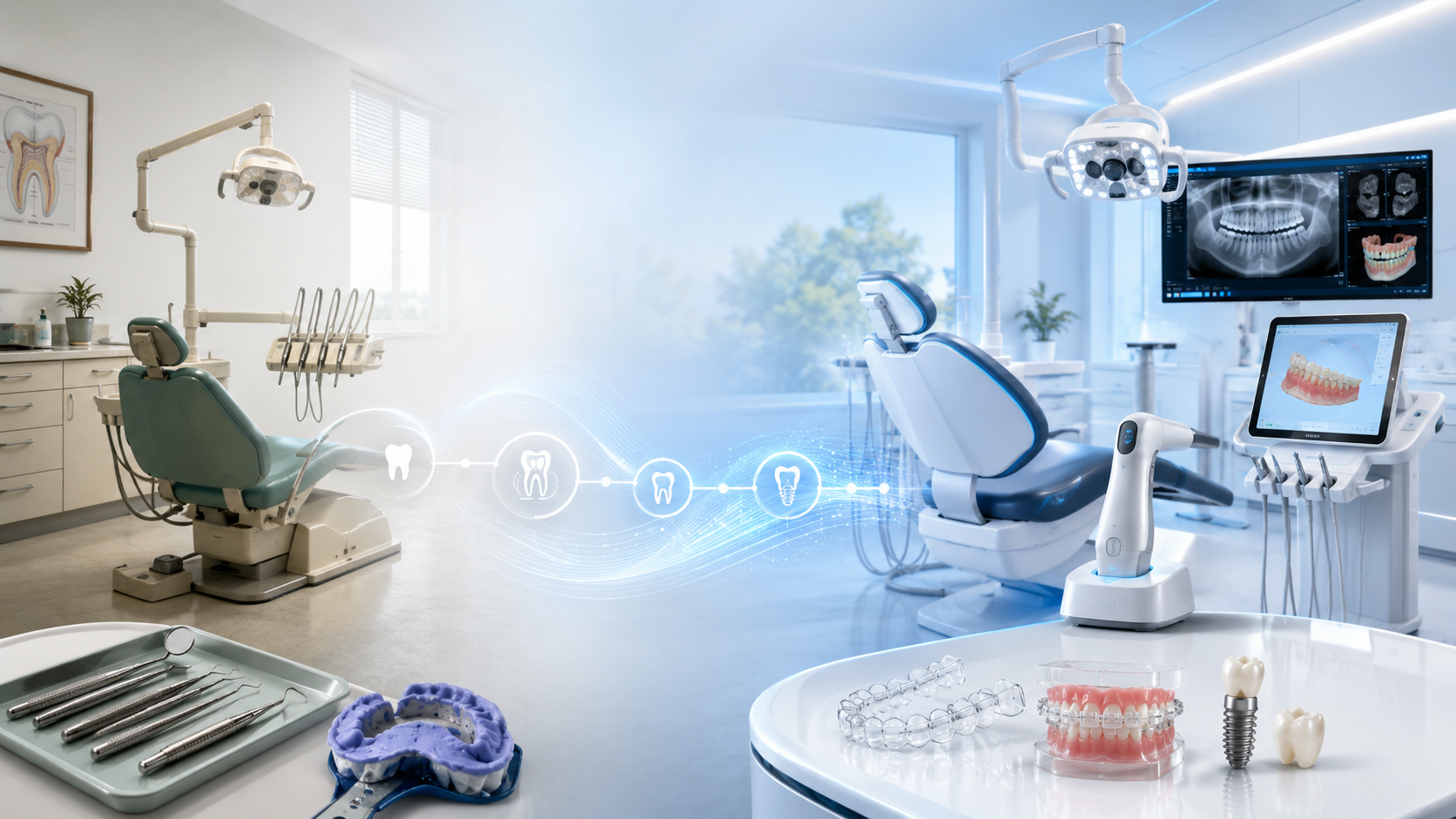
As we celebrate our 10-year anniversary, we've been reflecting on just how much has changed in dental care since we first opened our doors. The patient who walked into a dental office a decade ago would barely recognize what a modern visit looks like today. Goopy impressions, week-long waits for crowns, blurry film X-rays, and "drill-and-fill" as the default answer to every cavity. Much of that is fading into history.
Here are ten of the most exciting changes we've seen reshape dentistry over the past ten years.
1. Goodbye Goop: Digital Impressions
If you've ever had a mouthful of cold, gag-inducing putty pressed against your teeth, you'll appreciate this one. Intraoral scanners are small wands that capture thousands of images per second, and they've replaced traditional impression trays for most procedures. In a few minutes, your dentist now has a precise 3D digital model of your teeth, ready to send straight to a lab or in-house mill. No mess, no waiting, no second tries because the mold slipped.
2. Same-Day Crowns Became a Real Thing
Crowns used to mean two appointments, a temporary crown that often fell off at the worst possible moment, and a two-week wait. Thanks to CAD/CAM technology and in-office milling units, many practices can now design, mill, and place a permanent crown in a single visit. Drive in with a cracked tooth in the morning, drive home with a finished crown by lunch.
3. 3D Printing Quietly Took Over the Dental Lab
3D printing went from "interesting concept at a conference" to everyday workflow surprisingly fast. Aligner trays, surgical guides for implants, night guards, denture bases, models for treatment planning: all of these are now routinely 3D printed. The result is faster turnaround, better fit, and lower costs for patients.
4. AI Joined the Diagnostic Team
Artificial intelligence is now reading dental X-rays alongside your dentist. Tools like Pearl and Overjet are trained on millions of images and can flag early-stage cavities, bone loss, and other issues that might be missed by the naked eye. Importantly, AI doesn't replace your dentist's judgment. It acts as a second set of eyes, and it gives patients a clearer, more visual explanation of what's actually happening in their mouth.
5. Clear Aligners Went Mainstream
A decade ago, "orthodontics" still meant metal brackets and wires for most people. Today, clear aligners have become the default first option for a huge range of cases, and not just for teens. Adults make up a growing share of orthodontic patients, often because aligners are nearly invisible, removable for meals, and treatment timelines have gotten shorter as the technology has matured.
6. 3D Imaging Came to the Operatory
Cone Beam CT (CBCT) imaging gives dentists a full three-dimensional view of your jaw, sinuses, nerves, and tooth roots, something a traditional flat X-ray simply can't show. What was once a specialist-only tool is now common in general practices. It's transformed implant planning, root canal diagnosis, and the evaluation of impacted wisdom teeth, making procedures both safer and more predictable.
7. Teledentistry Found Its Footing
The pandemic accelerated a shift that was already underway: virtual consultations for things that don't require hands in your mouth. Reviewing a chipped tooth, deciding whether something is urgent, following up after a procedure, monitoring orthodontic progress. All of this can now happen over a video call. It's not a replacement for in-person care, but it's a huge convenience layer that didn't really exist ten years ago.
8. Lasers Became Standard, Not Exotic
Dental lasers used to feel like science fiction reserved for boutique offices. Today, both soft-tissue and hard-tissue lasers are common in general practice. They're used for gum reshaping, treating cold sores, frenectomies, and even some cavity preparations, often with less bleeding, less swelling, and reduced need for anesthesia.
9. Cavities Without Drilling: Silver Diamine Fluoride
One of the quieter revolutions in dentistry has been the rise of minimally invasive treatments, and silver diamine fluoride (SDF) is a great example. A simple liquid that's painted onto a decayed tooth, SDF can stop a cavity in its tracks without any drilling or numbing. It's especially valuable for young kids, anxious patients, and older adults for whom traditional restorations may be difficult. It does darken the treated area, so it's not right for every situation, but it's given dentists a whole new tool that didn't exist as a mainstream option a decade ago.
10. Implants Got Smarter, Faster, and More Predictable
Dental implants have existed for decades, but the last ten years have transformed how they're placed. Guided implant surgery, where the placement is planned digitally on a 3D scan and executed using a custom 3D-printed surgical guide, means smaller incisions, faster healing, and far more precise positioning. Same-day implants, full-arch restorations like "All-on-4," and improved materials have made tooth replacement more accessible than ever.
Looking Ahead
Ten years from now, this list will probably look quaint. AI-assisted treatment planning will likely be invisible-but-everywhere, new biomaterials may let us regrow tooth structure instead of replacing it, and tools we can't yet imagine will be standard equipment.
What hasn't changed, and what we don't expect to change, is the part that matters most: a real person, sitting across from you, listening to your concerns and helping you make a decision that's right for your health and your life. The technology is wonderful, but it's only useful in the hands of a team that knows you.
Thank you for being part of our first ten years. We can't wait to see what the next ten bring.
Have questions about any of the technologies mentioned above, or curious whether something on this list might be right for you? Give us a call. We'd love to talk.