

Dental Implants vs. Bridges: Which Is Right for You?
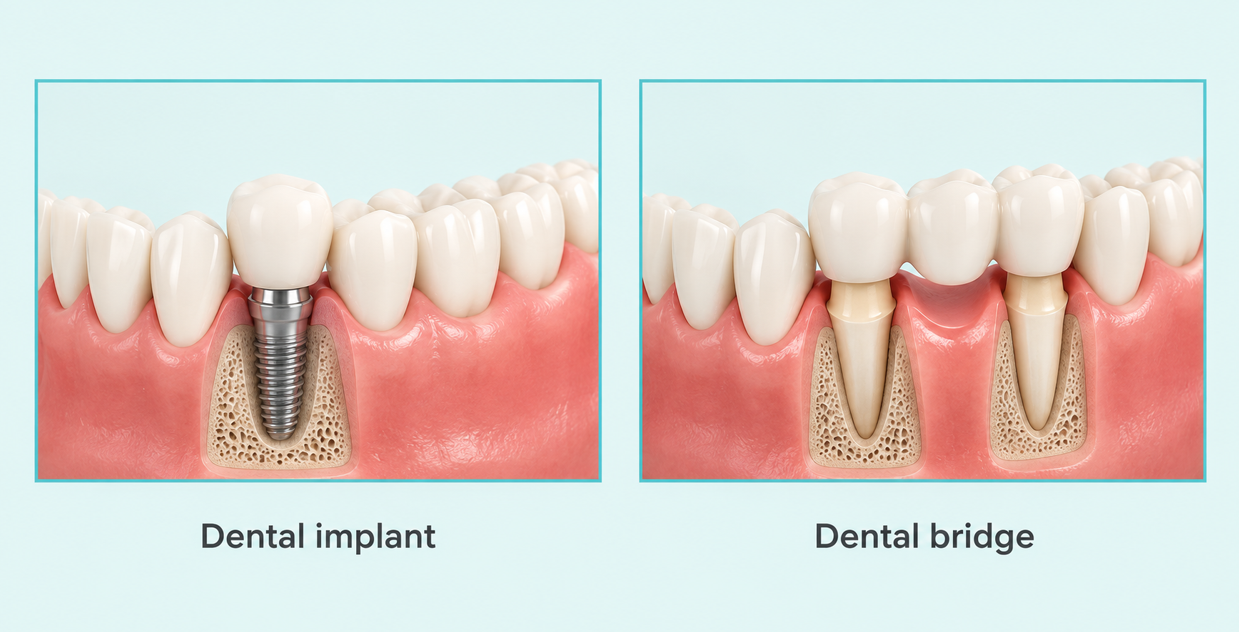
Implants vs Bridges: A guide to choosing the right replacement for a missing tooth
Replacing a missing tooth can make everyday moments, from enjoying a meal to smiling for a photo, feel more comfortable. Dental implants and bridges are two common options, but choosing between them involves more than comparing appearances.
An implant may appeal to someone who wants to preserve neighboring teeth and is comfortable with surgery and a longer treatment timeline. A traditional bridge may suit someone seeking a quicker option with a lower upfront cost. The right choice depends on your mouth, health, priorities, and budget.
How a dental implant works
A dental implant is a small post placed surgically in the jawbone to replace a missing tooth root. For a single missing tooth, a custom crown becomes the visible replacement tooth. The crown is made to blend with the size, shape, and color of your natural teeth.
After placement, the surrounding bone needs time to bond with the implant. This healing process, called osseointegration, creates a stable foundation. Treatment commonly takes several months, although the sequence varies. Ask whether a temporary tooth is appropriate while your implant heals.
A major advantage is that the replacement does not require reshaping nearby teeth for support. Implants can also support bridges or dentures when more than one tooth is missing.
How implant treatment works: American Dental Association
How a traditional dental bridge works
A bridge fills a gap with an artificial tooth, or several artificial teeth. A traditional bridge is supported by crowns attached to the natural teeth on either side of that gap. Those supporting teeth must be reshaped to make room for the crowns.
A fixed bridge stays in your mouth and is removed only by a dentist. Its support comes from the neighboring teeth, so keeping those teeth and their gums healthy is essential. This article focuses on traditional bridges; other designs use different methods of attachment.
Understanding fixed bridges: American Dental Association
Comparing cost and treatment time
A traditional bridge usually costs less upfront than an implant. Insurance may contribute to either option, but benefits depend on your specific plan. Ask for a written estimate showing the complete treatment and your expected share of the cost.
When comparing estimates, ask what is included: examinations, imaging, extractions, temporary teeth, the final restoration, and any additional procedures. A lower initial price is only one part of the decision. Future maintenance and replacement also deserve consideration.
A traditional bridge can often be completed over a few weeks once the supporting teeth and gums are ready. Extraction healing or other dental treatment may extend that timeline. Implants usually require a longer healing period before the final replacement is attached.
Factors that can influence your choice
The condition of your neighboring teeth matters. If they are healthy and intact, ask about the benefit of preserving their structure with an implant. If they already need crowns, ask whether a bridge would be reasonable. That is a discussion point, not an automatic recommendation: the teeth still need adequate strength and support.
For an implant, your dentist will assess the available jawbone and review your medical history. Bone grafting may be needed when bone volume is insufficient. Untreated gum disease, unmanaged diabetes, and smoking can affect suitability or healing. A diagnosis alone does not settle the decision; an individual evaluation does.
Implants can help preserve jawbone where a tooth has been lost. They also involve surgery, so ask about your personal risks and recovery needs before deciding.
Implant benefits and candidacy: Cleveland Clinic
Explore your options with iDental
You do not need to choose a treatment before your first appointment. Start by sharing what matters most to you, whether that is preserving your teeth, managing costs, or understanding the recovery time.
If you are considering dental implants or a bridge in Racine or Mount Pleasant, schedule a consultation with iDental Orthodontics & Family Dentistry. We can discuss your concerns and help you understand the next steps toward replacing your missing tooth.